 daynentang.com
Family 2–8 · Week 1 · G1
Honest and light
1.Goals
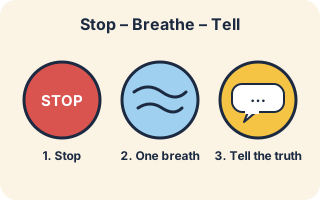
- Older child: retells the story of Ti the Dinosaur and practises owning up in 3 steps: stop – breathe – tell.
- Toddler: points or says “me” when asked who knocked down the block tower.
2.Get ready (5 minutes)
- The story below (printed or read from paper).
- 6–8 big wooden blocks or Duplo bricks, 1 cuddly cushion.
- A quiet place to sit, TV off.
3.Opening (2 minutes)
“Have you ever knocked something over or broken something? How did your tummy feel?” Listen to your child without comment.
4.Main activity
Story: Ti the Dinosaur and Grandma’s flower pot
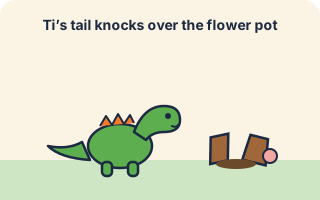
Ti the Dinosaur loved running round and round Grandma’s garden. One day, Ti swished that big tail too hard. Grandma’s flower pot fell over and broke in two.
Ti stood very still. Ti’s tummy felt heavy, as if Ti had swallowed a stone. Ti thought: “Maybe I could run behind the house. Nobody would know.”
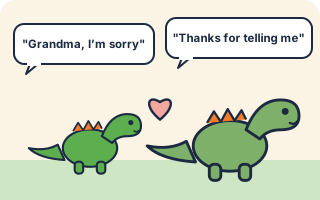
But Ti stopped. Ti took a big, deep breath, and let it out very slowly. Then Ti went inside and said quietly: “Grandma, my tail broke your flower pot. I’m sorry.”
Grandma gave Ti a hug: “Thank you for telling me the truth. A broken pot can be replaced. I’m so glad you told me.”
Together they moved the soil into a new pot. The flowers were still fresh. Ti’s tummy felt light again, as if Ti had just put the stone down.
A new story written for daynentang.com.
Older child (15–20 minutes)
- Listen (4 minutes): read slowly. Pause where Ti thinks about running away and ask: “What do you think Ti will do?”
- Retell (4 minutes): the child retells the story in their own words. The cushion can be Ti.
- Practise Stop – Breathe – Tell (5 minutes): you give a situation, the child does the 3 steps. Example: “You spilled water on the table.” Child: stops, takes one breath, says “Dad, I spilled the water.”
- Swap roles (4 minutes): you “accidentally” knock something over and own up; the child plays Grandma and says: “Thank you for telling me the truth.”
- Our family rule (2 minutes): say it out loud together: “When we tell the truth, we say thank you. Then we fix it together.”
Toddler (5–10 minutes)
- Build a 6-block tower together.
- Let the toddler knock it down. Ask playfully: “Who knocked the tower down?”
- The toddler points or says “me”. Smile: “Thank you for telling me! Let’s build it again.”
- Repeat 3–4 times. The toddler learns “thank you for telling me” through play.
5.Questions to talk about
- When Ti thought about running away, how did Ti’s tummy feel? And after telling the truth?
- What did Grandma do when Ti told the truth?
- If you break something, what would you like us to say to you?
6.Safety
- Blocks must be bigger than a toilet-paper tube. Build on a rug, never taller than the toddler’s head.
- This lesson uses no threats or punishment. If your child owns up to a real mistake during the session, say thank you first and fix it after.
7.For the parent teaching alone
You only need: the printed story, 6 blocks, 1 cushion. 20 minutes in total. Evening, before bedtime, works well.
- Minutes 0–2 – Opening. Ask: “Have you ever broken something?” Just listen; don’t bring up your child’s old mistakes.
- Minutes 2–6 – Read the story. Read slowly. Where Ti thinks about running away, pause and ask: “What do you think Ti will do?”
- Minutes 6–10 – Toddler tower game. You build, the toddler knocks it down. Ask “Who knocked it down?”; the toddler points; you say thank you. The older child helps rebuild.
- Minutes 10–15 – Practise the 3 steps. Give 2 situations: “You dropped a bowl”, “You tore your sibling’s book”. The older child does: stop – breathe – tell.
- Minutes 15–18 – Swap roles. You pretend to knock something over; the older child plays Grandma and says: “Thank you for telling me the truth.”
- Minutes 18–20 – Our family rule. Everyone says: “When we tell the truth, we say thank you. Then we fix it together.”
The most important part: this week, whenever your child owns up to a real mistake, say “thank you for telling me the truth” first. Then fix it together.
Avoid: threats like “your nose will grow if you lie” or “liars get punished”. Threatening stories don’t make children more honest (see sources).
If the older child asks “Have you ever lied?”: answer honestly and briefly. For example: “Sometimes I was scared too. But after telling the truth, I felt lighter.”
Send the other parent one line: which part of the story the child liked.
8.Review
- After 1 day: at bedtime, ask the child to retell one sentence from the Ti the Dinosaur story.
- After 1 week: ask “Was there a time this week you told the truth even though you were a bit scared?” If yes, thank them again.
9.After-session journal
| What my child could do | |
|---|---|
| What my child enjoyed | |
| What to change |
10.Sources and labels
- [Verified] A study of 268 children aged 3–7: only the story in which the character was praised for telling the truth increased confessions; stories threatening the consequences of lying worked no better than an unrelated story (Lee, Talwar et al., Psychological Science, 2014; APS summary).
- [Verified] When the story’s ending was changed to a negative one, the effect disappeared; long-term effects have not been tested (same source).
- [Inference] “Thank first, fix after” applies this finding to family life; the study did not test this exact approach.
- [Expert judgement] “Ti the Dinosaur” is a completely new story; it borrows only the idea of praising the truth-teller.
daynentang.com · CC BY-NC-SA 4.0 · Translated from Vietnamese · Updated 3 November 2026