 daynentang.com
Family 2–8 · Week 1 · K1
Float or sink?
1.Goals
- Older child: guesses and then tests 8 objects, records the results, and can say “heavy things don’t always sink”.
- Toddler: drops objects into the water and says or points to “float” or “sink”.
2.Get ready (5 minutes)
- 1 large plastic tub with water about 10–15 cm deep. Put it on an old bath towel on the floor.
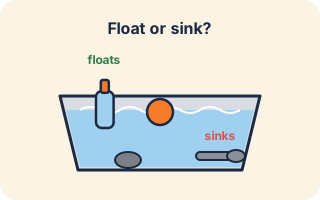
- 8 big objects (all bigger than a toilet-paper tube): large metal spoon, empty plastic bottle with the cap on, full plastic bottle with the cap on, unpeeled orange, wooden toy block, plastic bowl, fist-sized stone, big Lego/Duplo brick.
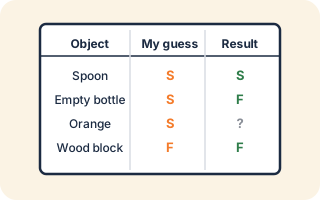
- 1 sheet of paper with 3 columns: Object · My guess · Result.
- 1 plastic basket or colander to scoop things out.
3.Opening (2 minutes)
Hold up the metal spoon and the empty bottle: “Which one is heavier? Which one will sink?” Let the child guess. Don’t give the answer yet.
4.Main activity – Look → Guess → Try → Tell
Older child (20–25 minutes)
- Look: the child holds each object and says if it is heavy or light, hard or soft, hollow or solid.
- Guess: the child writes “F” (float) or “S” (sink) in the “My guess” column for all 8 objects.
- Try: the child drops each object in and records the result. A wrong guess gets a question mark, not a cross.
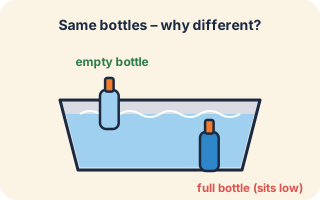
- Surprise comparison: put the empty bottle and the full bottle side by side. They look the same – why does the full bottle sit so much lower?
- Extra test: float the plastic bowl like a boat. The child adds Lego bricks one at a time. Count how many bricks it takes to sink the bowl.
- Tell: the child tells you the one thing that surprised them most.
Toddler (5–10 minutes)
- Sit right next to the tub; the adult sits beside the toddler, hands within reach.
- Hand over one object at a time: “Drop it!” Then say: “It floats!” or “It sinks, down to the bottom!”
- Let the toddler scoop things out with the plastic basket.
- Repeat the objects the toddler likes. Two-year-olds love repetition; that is how they learn.
5.Questions to talk about
- Which object did you guess wrong? What will you look at next time before you guess?
- How are the empty bottle and the full bottle different?
- What else at home would you like to test next time?
6.Safety
- An adult sits close, with the toddler always within arm’s reach. If the doorbell or phone rings, take the toddler with you.
- Never let the older child watch the toddler at the tub.
- When you finish: empty all the water straight away, turn the tub upside down and store it out of reach.
- Wipe up spilled water at once so nobody slips.
- Every object must be bigger than a toilet-paper tube. No marbles, bottle caps, batteries or small magnets.
7.For the parent teaching alone
You only need: a tub of water, an old towel, 5 objects (metal spoon, empty bottle, full bottle, orange, wooden block), paper and a pen. 20 minutes in total.
Before you start: put your phone away and sit right by the tub. If you have to leave, stop the session and take the toddler with you.
- Minutes 0–2 – Opening. Hold up the spoon and the empty bottle: “Which one will sink?” The child guesses; you don’t answer yet.
- Minutes 2–6 – Guess. The older child writes F or S for 5 objects. The toddler watches and holds each object.
- Minutes 6–12 – Try. The children take turns. The toddler drops, the older child records.
- Minutes 12–15 – Surprise. Float the empty and full bottles side by side. Ask: “Why are the two bottles different?”
- Minutes 15–18 – Tell. The older child shares one surprise. Photograph the record sheet for the other parent (never the children’s faces).
- Minutes 18–20 – Tidy up. Empty the water at once, turn the tub over, wipe the floor. The older child helps wipe.
If the child asks “why” and you’re not sure: “I don’t know yet either. Let’s write it down and ask later.” You don’t need the right answer straight away.
A simple idea to share with the older child: things with a lot of air inside often float more easily. Big or heavy doesn’t always mean it sinks.
Skip the “Extra test” (Lego in the bowl) if you are on your own. Save it for when both parents are home.
8.Review
- After 1 day: at bath time, hand the child one new (safe) object and ask “Float or sink?” before dropping it.
- After 1 week: look at the record sheet again. How many guesses were right? Test 3 new objects the child chooses.
9.After-session journal
| What my child could do | |
|---|---|
| What my child enjoyed | |
| What to change |
10.Sources and labels
- [Verified] Young children can drown in just a few inches of water; keep them within arm’s reach, empty water after use, and don’t let older children supervise younger ones at bath time (US Consumer Product Safety Commission).
- [Expert judgement] We don’t predict the result for each object (for example, the orange). That is for the child to test.
- [Expert judgement] “Lots of air inside means it floats more easily” is a simple way of saying it for children, not a full definition of buoyancy.
daynentang.com · CC BY-NC-SA 4.0 · Translated from Vietnamese · Updated 3 November 2026