 daynentang.com
Family · Course G3 · Trial version
Family 2–8: The Foundation Hand
Parents, even one parent alone, build three foundations through 30 minutes of purposeful play: self-reliant habits, a curious, testing mind, and kind values. And there is less shouting at home.
| For | Parents, grandparents and carers of children aged 2–8 |
|---|---|
| Length | 12 weeks × 3 sessions × 30 minutes. About 30 minutes of preparation per week |
| You need | Things already at home, paper, chunky crayons. Children need no screens |
| Status | All 12 weeks written in Vietnamese. Week 1 is translated and was tried in one family; weeks 2–12 are not yet tried |
Help now (1–2 weeks)
- A fun play time with your child every day.
- Your child does at least one small job alone.
- You have ready-made phrases to use instead of shouting.
Build for the long term
- Executive function: attention, working memory, self-control.
- The habit of asking, guessing and checking.
- Honesty, gratitude, kindness, responsibility.
The Foundation Hand
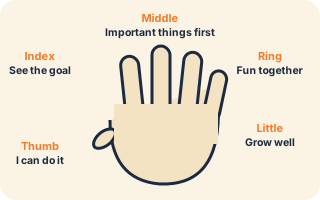
Five fingers are five habits. Children look at their own hand and remember.
| Finger | Habit |
|---|---|
| Thumb | I can do it myself |
| Index finger | Look at the goal, then go |
| Middle finger | Important things first |
| Ring finger | Listen – understand – have fun together |
| Little finger | Grow well: sleep, food, movement, calm |
The 12 weeks
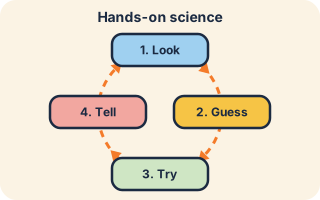
Three sessions each week: T Habits, K Hands-on science (Look → Guess → Try → Tell), G Values and mindfulness. Week 1 is in English. For weeks 2–12, open the Vietnamese course page; your browser can translate it.
| Week | T – Habits | K – Science | G – Values | Measurable goal |
|---|---|---|---|---|
| 1 | I can do it myself | Float or sink? | Honest and light | Older child: does the chosen job alone ≥4 of 7 days. Toddler: puts away 3 toys when reminded |
| 2 | Try – fail – try again | Water: pour, measure, soak | Three thank-yous | Older: says “I’ll try another way”. Toddler: pours water from a small jug |
| 3 | Look at the goal, then go | Bean seeds sprouting | Secret good deeds | Older: sets 1 goal and checks it. Toddler: picks 1 of 2 job pictures |
| 4 | Before – During – After | How tall is the sprout? | Stop – Breathe – Talk | Older: draws a 3-step plan. Toddler: points to 2 feeling faces |
| 5 | Important things first | Light and shadow | My own housework | Older: main job first ≥4 of 7 days. Toddler: tidies up with a song |
| 6 | Red light – green light | Slopes and force | Owning and fixing mistakes | Older: stops on signal ≥8/10. Toddler: ≥5/10 |
| 7 | The talking stick | Mystery bag | Feelings detective | Older: repeats what someone said. Toddler: waits for a turn once |
| 8 | Big sibling teaches | Weather around the house | Thanking workers | Older: teaches the sibling 1 task. Toddler: follows 1 step |
| 9 | Grow well: sleep, food, movement | Dinosaurs and fossils | Walk slowly, eat slowly | Regular bedtime ≥5 of 7 days (both children) |
| 10 | A calm-down corner | Design a boat that carries the most | Keeping small promises | Older: uses the calm corner once. Toddler: accepts a hug or breathing together |
| 11 | The whole hand: a family vegetable pot | I ask – I test | Being kind to yourself | Older: asks a question and predicts. Toddler: names 3 plant parts |
| 12 | Foundation Hand celebration | Family science fair | Review values, draw a wish | End-of-course review |
“Older child” = about 7 years old; “toddler” = about 2 years old. Adjust to your own children’s ages.
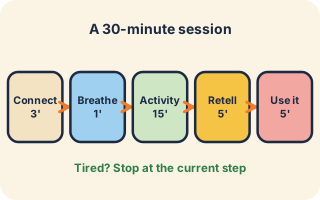
One 30-minute session
- Connect (0–3′): say hello, sit close. The toddler sits on your lap.
- Breathe for 1 minute (3–5′): “smell the flower – blow out the candle”.
- Main activity (5–20′): two levels, for the older child and the toddler.
- Child retells (20–25′): the toddler points, names or copies.
- Take it into daily life (25–30′): pick one thing to do this week, add a sticker.
A 2-year-old joins for 10–15 minutes, then plays alongside. Don’t make them sit for the full 30 minutes.
Track progress
Score the observation chart (Vietnamese) at weeks 0, 6 and 12: 0 = not yet, 1 = with a reminder, 2 = on their own. Also count, over 3 days, how often you give specific praise and how often you shout. This is self-tracking, not a test.
Where the method comes from
| Source | Idea we borrow | Evidence |
|---|---|---|
| Parenting for Lifelong Health (WHO/UNICEF) | One-to-one play, specific praise, clear instructions, non-violent consequences | [Verified] Randomised trial in South Africa (296 caregivers): observed positive parenting +39% after 4–5 months (Ward et al. 2019) |
| Executive function activities guide (Harvard) | Games by age, 18–36 months and 5–7 years | [Verified] Expert guidance, not a randomised trial |
| CASEL | Naming goals after five social-emotional competencies | [Verified] Meta-analysis of 424 studies (Cipriano et al. 2023), mostly in schools |
| Reach Up | Play with home-made toys for young children | [Verified] Long-term follow-up in Jamaica (Gertler et al.) |
| Lee, Talwar et al. 2014, Psychological Science | Stories that praise honesty | [Verified] 268 children aged 3–7; short-term effect |
Limits, honestly
[Inference] Most of these programmes were tested in groups with a facilitator. Self-study at home has not been shown to work as well. This course is being tried in one family, with no comparison group. We make no promises about grades or IQ.
Watch before you teach
- 5 Steps for Brain-Building Serve and Return – Harvard Center on the Developing Child (video)
- Executive function activities guide – Harvard (PDF)
- Reach Up – resources and videos
Safety for every session
- Under 3s: keep small objects out of reach. Home tip: anything that fits through a toilet-paper tube is too small.
- No button batteries, small magnets, plastic bags or sharp knives and scissors near the toddler.
- Water play: an adult always within arm’s reach; empty the water right after.
Get help now
In Vietnam: child in danger or abused – call 111 (free, 24/7). Medical emergency – 115. Depression or thoughts of self-harm – 096 306 1414 (Ngày Mai line, Vietnamese). Elsewhere: call your local emergency number. More help.