 daynentang.com
Family 2–8 · Week 1 · T1
I can do it myself
1.Goals
- Older child (about 7): names all 4 steps of one morning job and picks 1 job to do alone this week.
- Toddler (about 2): puts 3 toys into a basket after one reminder.
2.Get ready (5 minutes)
- 1 sheet of A4 paper and chunky crayons. No pens with small caps near the toddler.
- 1 basket and a few of the toddler’s big toys.
- Tape or a large fridge magnet to put the chart up.
3.Opening (2 minutes)
Hold up your thumb and ask: “This finger helps us hold things. What did you do by yourself this morning?” Everyone gives a thumbs-up when someone names a job.
4.Main activity
Older child (15–20 minutes)
- Warm-up: “Dad says” (3 minutes): only do the action if the sentence starts with “Dad says” (or “Mum says”). Example: “Dad says touch your nose”, then “Touch your ear” (don’t move!).
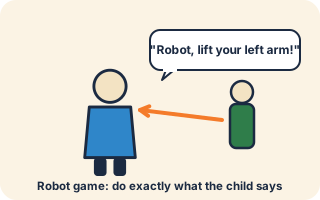
- The Robot game (5 minutes): the parent is a robot and does exactly what the child says, step by step. The child tells the robot how to put on a jacket. The robot gets it wrong on purpose when a step is missing.
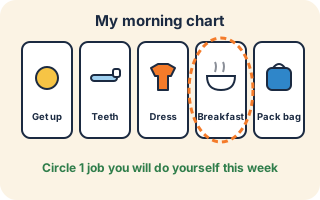
- Draw a “Morning chart” (7 minutes): the child draws 4–5 boxes, one job per box: get up, brush teeth, get dressed, eat breakfast, pack the school bag.
- Choose a job (3 minutes): the child circles 1 job that a parent usually does for them. This week the child does it alone.
- Put the chart where the child sees it every morning.
Toddler (5–10 minutes)
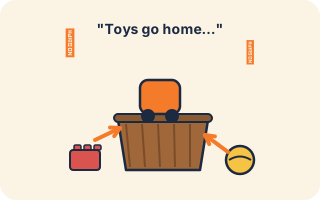
- Put 3 big toys on the floor with the basket nearby.
- Sing slowly: “Toys go home, go home, go home” and put 1 toy away to show how.
- Invite the toddler to put the other 2 away. When done, everyone gives a thumbs-up.
- If the toddler doesn’t want to, hold their hand and put 1 toy away together, then stop.
5.Questions to talk about
- When the robot got it wrong, how did you feel? Why did it go wrong?
- Which job would you like to do alone that nobody has let you try yet?
- If you try by yourself and it doesn’t work yet, what will you do next?
6.Safety
- Toddler: use only toys and crayons that do not fit through a toilet-paper tube. Put away pen caps and broken crayon bits.
- Robot game: clear a wide space with no sharp table corners nearby.
7.For the parent teaching alone
You only need: 1 sheet of paper, chunky crayons, 1 basket. 20 minutes in total.
- Minutes 0–2 – Opening. Thumbs up: “What did you do by yourself this morning?” Everyone gives a thumbs-up for each job.
- Minutes 2–5 – “Mum says” / “Dad says”. Play as above. The older child can give the orders for one round.
- Minutes 5–12 – Draw the chart. Skip the Robot game if you are tired. The child draws 4–5 morning jobs.
- Minutes 12–15 – Choose a job. The child circles 1 job to do alone this week. Put the chart on the fridge.
- Minutes 15–20 – Toddler tidies up. Sing “Toys go home”, put 1 toy away to show, the toddler puts away 2.
When the child manages: “You worked hard at that yourself!” Praise the effort, not “you’re so clever”.
When it doesn’t work yet: “Not yet. Do you want to try again, or shall I show you one step?”
When the child is tired or fussy: stop at the current step. A half-drawn chart can still go on the fridge.
Send the other parent one line: which job the child chose to do alone.
8.Review
- After 1 day: next morning, point to the chart: “Which job will you do yourself today?” The child ticks it.
- After 1 week: count the days the child did the chosen job alone. Pick a second job if the child wants.
From our trial session (28 October 2026)
- The older child (7) did 3 of 5 morning jobs alone: brushing teeth, getting dressed, eating breakfast.
- The child chose to move “putting toys away” from “parent helps” to “I do it” next week.
- The child loved the “Dad says” and Robot games.
Notes from the author’s own family, with identifying details removed. One family is not enough to judge whether the lesson works.
9.After-session journal
| What my child could do | |
|---|---|
| What my child enjoyed | |
| What to change |
10.Sources and labels
- [Verified] “Simon says”-type games appear in the activity ideas for ages 5–7 from the Harvard Center on the Developing Child.
- [Expert judgement] The morning chart and the Robot game were designed by daynentang.com; there is no study of them.
- [Inference] Praise effort rather than “clever”. “Growth mindset” interventions have only very small effects, so we pair the praise with concrete actions such as trying again or changing the approach.
- [Expert judgement] The toilet-paper-tube tip is a quick home check, not a replacement for toy safety standards.
daynentang.com · CC BY-NC-SA 4.0 · Translated from Vietnamese · Updated 3 November 2026